3 Instagram Ads Reports That Simplify Your Marketing

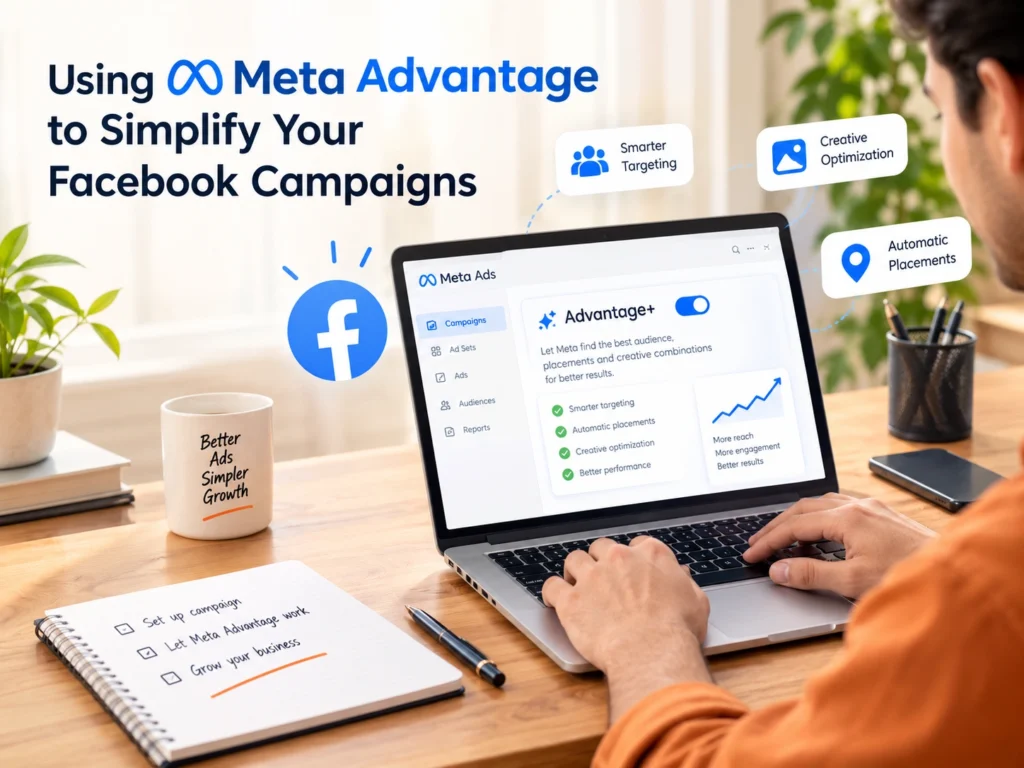
Running Facebook advertising can become complicated quickly. You may need to think about audiences, placements, budgets, creatives, bidding, and campaign optimization all at once.
Meta Advantage+ is designed to simplify many of these decisions by using automation and machine learning within Meta Ads Manager. Instead of manually controlling every part of a campaign, advertisers can provide their business goal, creative assets, budget, and important audience inputs while Meta’s systems help automate parts of campaign delivery.
For businesses that want a simpler advertising workflow, understanding Meta Advantage+ can be useful.
What Is Meta Advantage+?
Meta Advantage+ is a collection of automated advertising tools available through Meta’s advertising platform.
Depending on the campaign and setup, Advantage+ can help with areas such as:
Advantage+ Audience, for example, allows Meta to use your audience inputs as guidance while its system can expand beyond those suggestions when it expects better results.
The exact options available can vary depending on the campaign objective, account, and current Ads Manager interface.
Why Use Meta Advantage+?
Traditional advertising often requires advertisers to make many decisions before launching a campaign.
You might manually select:
Advantage+ can automate some of these decisions, allowing advertisers to spend more time on the areas they control directly, such as their offer, creative ideas, tracking, and overall marketing strategy.
This can also make campaign creation less complicated for businesses that don’t want to manage every technical setting manually.
1. Let Meta Help Find Your Audience
Audience selection is one of the most important parts of Facebook advertising.
With Advantage+ Audience, you can provide audience suggestions and relevant controls while Meta’s system can use its machine-learning capabilities to find additional people who may be more likely to take your desired action.
For example, a business selling fitness products might provide relevant audience information as a starting point. Meta can then use available signals and campaign performance to help identify people who are likely to respond.
This approach can reduce the need to create many narrowly defined audience groups.
2. Simplify Ad Placements
Your Facebook and Instagram ads can appear in different locations across Meta’s platforms.
Instead of manually selecting every placement, Advantage+ Placements allows Meta to distribute ads across eligible placements and optimize delivery based on the campaign’s performance goal.
This can save time during campaign setup.
However, advertisers should still review placement-level results after the campaign starts. Automation does not remove the need for performance monitoring.
3. Give Meta More Creative Options
Creative testing is another area where automation can help.
Rather than relying on a single image or video, advertisers can provide multiple creative assets and text variations. Meta can then combine eligible assets and messages in different ways as part of the campaign setup. Meta’s developer documentation describes Advantage+ campaigns that can use multiple creative assets and text options to create different ad combinations.
For example, you could provide:
Having different creative options gives the system more material to work with while you continue to monitor which combinations generate useful results.
4. Focus on the Right Campaign Objective
Automation works best when Meta knows what you actually want from your advertising.
Before creating a campaign, decide whether your primary goal is something such as:
Your campaign objective influences how Meta optimizes delivery.
For example, a business looking for customers should not judge a sales campaign only by impressions. It should also examine meaningful actions such as purchases, qualified leads, or revenue.
The more clearly your campaign objective matches your actual business goal, the more useful your performance data can become.
5. Don’t Forget Tracking
Automation needs reliable information.
Before spending a significant advertising budget, make sure your website and conversion tracking are properly configured.
Depending on your setup, this may include:
If your important business actions aren’t being measured correctly, it becomes harder to understand whether your campaigns are actually producing valuable results.
6. Use Automation Without Giving Up Strategy
One common misunderstanding is that using Advantage+ means you no longer need a marketing strategy.
Automation does not replace strategy.
You still need to decide:
Who are you trying to reach?
What are you offering?
Why should someone choose your business?
What creative will communicate your message?
What action do you want people to take?
Meta can help optimize delivery, but the quality of your offer, creative, website, customer experience, and tracking still matters.
7. Review Your Results Regularly
Even when using automated campaigns, don’t simply launch your ads and forget about them.
Review metrics such as:
Look beyond inexpensive clicks or high engagement. The most useful metric depends on your campaign objective and business model.
For example, a campaign generating many clicks but very few qualified leads may need a different approach.
When Should You Consider Manual Controls?
Automation can simplify campaign management, but there are situations where advertisers may need more control.
Manual settings can be useful when you have a specific business requirement, need a controlled test, have placement restrictions, or need to separate campaigns for a particular reason.
The goal isn’t to automate everything simply because automation is available.
Instead, consider which decisions Meta can reasonably automate and which decisions are important enough for your business to control directly.
A Simple Meta Advantage+ Workflow
A basic workflow could look like this:
Step 1: Define Your Goal
Decide what you want the campaign to achieve.
Step 2: Check Tracking
Make sure important conversions and website actions are being measured correctly.
Step 3: Prepare Your Creative
Create several strong images, videos, headlines, and primary text options.
Step 4: Set Your Audience Inputs
Provide the appropriate audience information and important controls.
Step 5: Set Your Budget
Choose a budget that makes sense for your business and campaign objective.
Step 6: Launch and Monitor
Give the campaign enough time and data to evaluate performance while monitoring important metrics.
Step 7: Learn and Improve
Use the results to improve your offer, creative, landing page, and future campaigns.
Final Thoughts
Meta Advantage+ can make Facebook advertising easier by automating parts of audience selection, placements, creative combinations, and campaign delivery.
But automation should support your marketing strategy, not replace it.
The strongest approach is to give Meta good inputs: a clear campaign objective, accurate tracking, strong creative assets, a useful offer, and appropriate audience information. Then monitor the results and use the data to make better marketing decisions.
Facebook advertising doesn’t have to mean controlling every setting manually. With the right setup, Meta Advantage+ can help simplify campaign management while giving businesses more time to focus on their customers and overall marketing strategy.
Have a question or need a digital solution for your business? Get in touch with our team and let’s discuss how we can help.